
 İkizderi
The types of tool belts may look alike at first glance, but they differ a great deal in material, pocket layout, carrying system and, above all, the trade they are built for. An electrician’s belt and a formworker’s belt do not do the same job: one needs slim, snug slots for pliers and screwdrivers, the other needs deep pockets that take handfuls of nails. In this guide we sort the types of tool belts by structure and by trade, explain who each one suits, what its strengths are, and what to check before you buy. By the end you will be able to pick the right tool belt for your own work with confidence.
İkizderi · Genuine Leather
Handmade Genuine Leather Tool Belts
Multi-compartment leather tool belts, hand-stitched and reinforced with stainless-steel rivets in our workshop in Gerede, Bolu. Single pieces or production for your whole team.
What Is a Tool Belt and What Does It Do?
A tool belt is a piece of work equipment worn around the waist that uses pockets, slots and loops to carry hand tools in an organized way at the front or side of the body. It keeps the craftsman’s hands free, lets them reach a tool without looking, and removes the need to keep climbing down a ladder or scaffold to fetch something.
It goes by several names on the job site, such as tool pouch belt, tool carrying belt or work belt. All of them answer the same basic need: keeping the right tool within reach at the right moment. The differences appear in what job the belt is designed for. Models with an apron body that covers the torso are usually called aprons; in this article our focus is the belt systems worn at the waist. If you are curious about the apron-style models, see our guide to the types of craftsman aprons.
What Are the Types of Tool Belts? A Quick List
The easiest way to understand the types of tool belts is to think along two axes: the structure of the belt (how it carries) and the trade it serves (what it carries). By structure, seven main types stand out:
- Single-pocket waist belt: One deep pocket, for a small number of nails or screws.
- Multi-compartment (pocketed) tool belt: Three to six pockets of different sizes plus tool slots; the most common and most versatile type.
- Bandolier (wide-belt) tool belt: Built on a wide, sturdy belt that spreads a heavy load evenly around the waist.
- Suspender tool belt: Shoulder straps transfer part of the load to the shoulders.
- Hammer-loop and tool-slot belt: Few pockets, with hammer loops and tool holders in the foreground.
- Modular tool belt: Pockets can be slid along the belt or attached and removed.
- By material: Genuine leather, canvas and nylon/synthetic belts.
Below we open up each type one by one, then give the right matches by trade.
Who Is a Single-Pocket Waist Belt For?
A single-pocket waist belt suits users who carry a small amount of one kind of material and do short jobs. For craftsmen who work from one box of screws or a handful of nails and keep the tool in their hand, it is a light and practical solution.
Its biggest advantages are low weight and simplicity. But carrying nails and screws of different sizes in the same pocket makes it harder to find what you need; over a long, busy day these small delays add up to real lost time. That is why a single-pocket belt is usually chosen as a second belt or for light work. If you are wondering how many compartments you need, the logic is the same as with a nail apron: plan one compartment per type of fastener you use.
Why Is the Multi-Compartment Tool Belt the Most Popular?
The multi-compartment tool belt is the most popular type because it combines pockets of different sizes and tool slots in one belt. Nails, screws, wall plugs, a pencil, a tape measure and small hand tools all have their own place; the craftsman memorizes where everything is and reaches for it without looking.
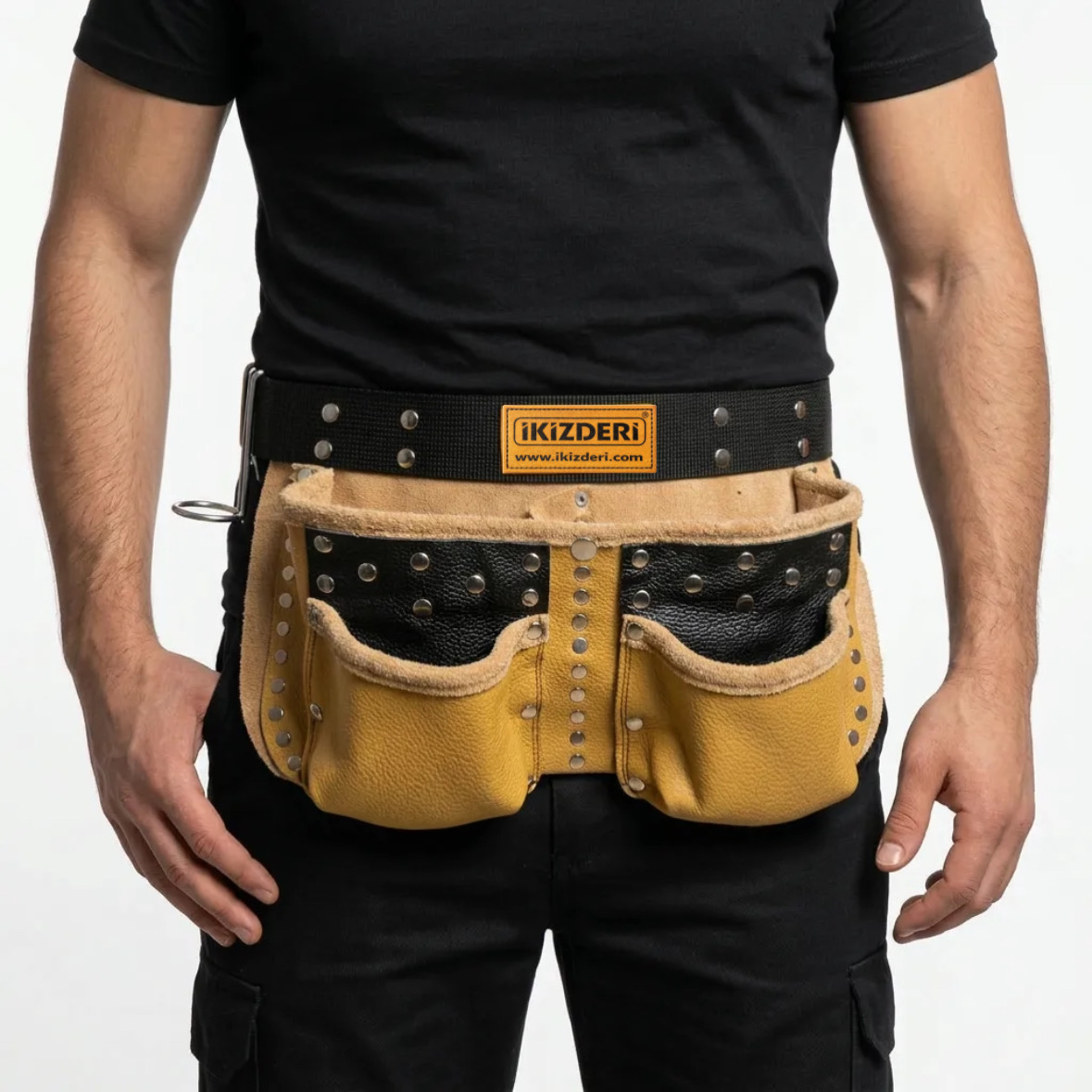
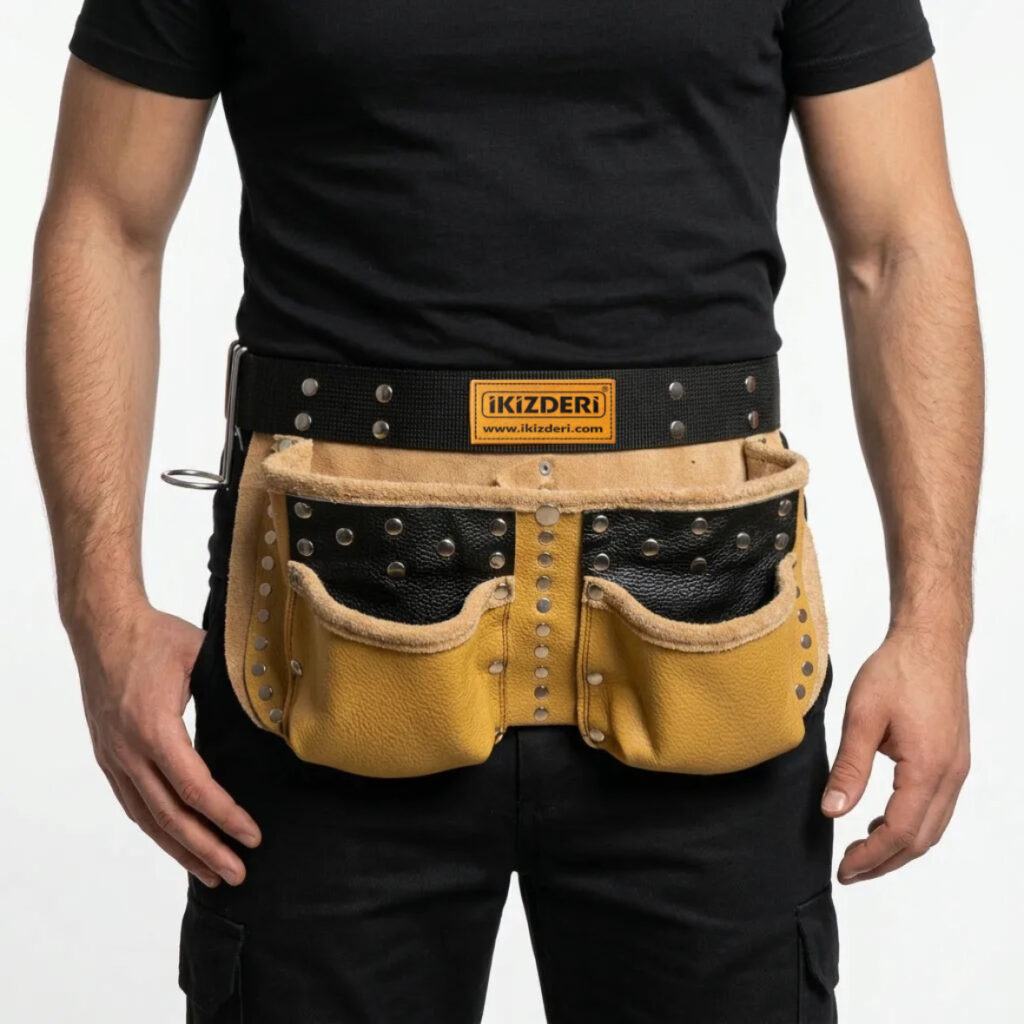
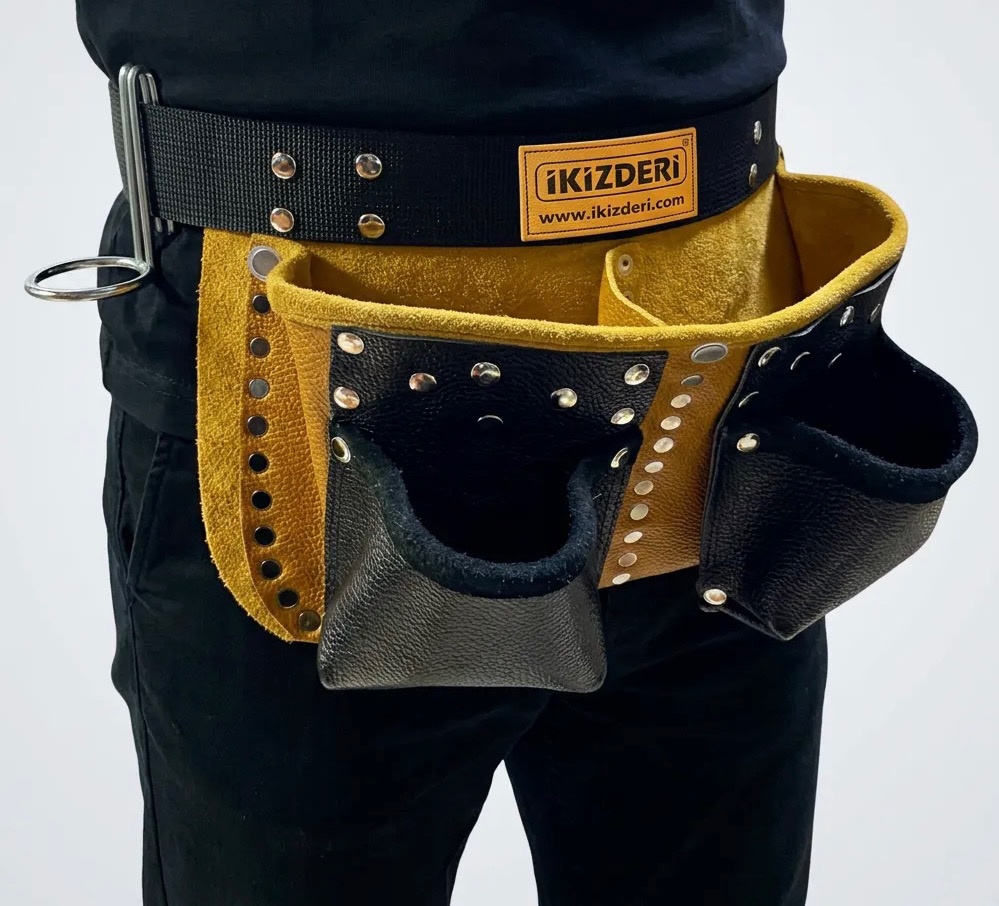
A typical multi-compartment belt has two large main pockets facing forward, smaller pockets in front of them, pencil and screwdriver slots at the sides, and a hammer or tape-measure holder. This layout is enough to do most of the job with a single belt. A multi-compartment belt made of genuine leather keeps the pockets from sagging under weight, and corners secured with stainless-steel rivets do not tear open under load.
İkizderi’s leather tool belt models are examples of this type: four compartments, hand-stitched and rivet-reinforced. We explain how rivets and stitching affect strength in our article on rivets and hand-stitching.
When Do You Need a Bandolier-Style Tool Belt?
A bandolier-style tool belt is needed for jobs where heavy tools and plenty of material are carried. The wide, sturdy belt spreads the load around the waist, reduces pressure on a single point, and keeps the belt from twisting and slipping.
In construction and formwork, where the pockets are full and you stand all day, a thin belt digs into the waist and becomes uncomfortable. A wide belt distributes the weight over a larger area. If you want to know where this belt style comes from and why it carries so evenly, read our article what is a bandolier belt. You can find the bandolier-belt models in our bandolier belt leather aprons category.
Doesn’t a Suspender Tool Belt Put Less Load on the Waist?
Yes. A suspender tool belt moves part of the load to the shoulders through straps that pass over them, so less weight sits on the waist. It is a relief especially for craftsmen with lower-back pain or a herniated disc who carry very heavy tools.
The straps also stop the belt from sliding down under weight. The downside is that it can feel a little more restrictive in hot weather and in very active work. If you are considering this type, pay attention to the width of the straps and whether they are adjustable; narrow straps dig into the shoulders. Seating the belt correctly on the waist matters as much as the straps; we explain the right height and adjustment step by step in our guide how to wear a leather tool belt.
What Is a Hammer-Loop and Tool-Slot Belt For?
A hammer-loop and tool-slot belt puts tool holders ahead of pockets. With parts such as a hammer loop, a tape-measure clip, and screwdriver and plier slots, the most frequently used tools come out and go back in with one movement.
This type is ideal for craftsmen who use few materials but many tools. In assembly and maintenance work, for example, plier, screwdriver and utility-knife slots are more useful than a nail pocket. Most multi-compartment belts also have a hammer loop and a few tool slots, so the line between the two is not sharp. When choosing, check that the slots are sized for your tools; a loose slot drops the tool, a tight one jams it.
Is a Modular Tool Belt a Good Choice?
A modular tool belt lets you rearrange the pockets by sliding them along the belt or attaching and removing them. It offers flexibility for craftsmen who want a different layout for different jobs.
Alongside the flexibility, the connection points can be the weak link. Parts that are constantly attached and removed loosen over time, and a connection opening under a heavy load is a real risk. For craftsmen who do the same job for years, a belt with pockets stitched and riveted permanently to the belt is usually more durable. A modular belt makes more sense for users who change jobs often and carry light loads.
Types of Tool Belts by Material: Leather, Canvas or Nylon?
Material decides how long a tool belt lasts and how it behaves under weight. In short: genuine leather is the longest-lasting and toughest option, canvas is lighter and cheaper, and nylon is inexpensive but the weakest against sharp tools.
- Genuine leather: Resists sharp points, abrasion and weight best. Over time it shapes itself to the craftsman’s use and lasts for years. It is a little heavier and needs occasional care.
- Canvas: Light and affordable. But nail points and blades gradually pierce the fabric, and it wears quickly with moisture and dirt.
- Nylon / synthetic: The cheapest option and good against water. It stretches under heavy load, pocket openings sag, and sharp tools cut the fabric easily.
You can find a detailed comparison of leather and canvas in our article leather vs canvas nail apron. If you are buying leather, you also need to know how to tell genuine leather from faux leather; we explain the methods in our guide how to tell if leather is real.
Tool Belt or Tool Apron?
A tool belt is worn only at the waist and carries its pockets at hip level; a tool apron adds a leather panel that covers the torso or the front of the legs. Put simply, a belt is lighter and freer, while an apron offers extra protection and more carrying space.
This difference is often overlooked when comparing the types of tool belts. If you need to protect your clothes from sparks, dirt or abrasion while you work, or you want to carry tools at chest level too, an apron with a body is the better choice. If you only want organized carrying at the waist and value freedom of movement, a belt is enough. You can find the apron-style models in our leather tool aprons and leather craftsman aprons categories, and the waist-style models among our tool belts.
As a practical rule: if you bend, kneel and squeeze into tight spaces often during the day, a belt without a body restricts you less. If you work for long periods at a bench or standing in one spot, the extra protection and larger pocket area of an apron serve you better. Many craftsmen who use both choose the belt for light jobs and the apron for heavy, dirty work.
Tool Belt Types Comparison Table
The table below compares the types of tool belts at a glance: who they suit, their main strength and what to watch out for.
| Type | Best for | Main strength | Watch out for |
|---|---|---|---|
| Single-pocket waist belt | Light, short jobs | Light and simple | Materials get mixed |
| Multi-compartment tool belt | Carpenters, construction, general trades | Everything has its place | Pocket count must match the job |
| Bandolier-style tool belt | Formwork, construction, heavy loads | Spreads weight evenly at the waist | Belt width and buckle |
| Suspender tool belt | Very heavy loads, sensitive lower back | Moves load to the shoulders | Strap width and adjustment |
| Hammer-loop / tool-slot belt | Electricians, assembly, maintenance | Fast access to tools | Slot size must fit the tool |
| Modular belt | People who change jobs often | Flexible layout | Connections loosen over time |
Tool Belts by Trade: Which Craftsman Uses Which?
The right tool belt for a trade is chosen according to the tools used most often in that job. The matches below are based on the needs we see most often on site.
Electrician’s Tool Belt
Electricians carry few materials but many hand tools: pliers, side cutters, a wire stripper, screwdrivers with different tips, a voltage tester and a tape measure. That is why slim, snug tool slots matter more than deep nail pockets on an electrician’s tool belt. Low weight also makes a big difference when you spend the day on a ladder. You can find models made for electricians in our electrician aprons category, and the features of the right apron in our article on the leather apron for electricians.
Construction and Formwork Tool Belt
In construction and formwork, nails and the hammer come first. You need deep pockets that hold plenty of nails, a strong hammer loop and a wide belt to carry the load. That is why bandolier-style and multi-compartment models are the usual choice on site. We cover site conditions in our leather apron for construction workers article and the special needs of formwork in our leather apron for formworkers guide.
Carpenter’s Tool Belt
Carpenters do fine work, using a pencil, tape measure, square, chisels and small nails often. A multi-compartment belt with medium-depth pockets, pencil slots and a tape-measure holder is ideal for a carpenter. We discuss choosing the right apron for a woodworking shop separately in our carpenter’s apron guide.
Drywall Installer’s Tool Belt
A drywall installer uses screws more than nails and keeps a cordless driver in hand or on the belt all the time. A belt with wide-mouthed screw pockets and a sturdy holder or holster for the driver speeds up the work. Details are in our article on the leather apron for drywall installers.
Plumber’s and Gardener’s Tool Belt
Plumbers work with heavy wrenches in damp places; deep, sturdy pockets and moisture-resistant material come first (see our tool aprons for plumbers). Gardeners carry pruning shears, gloves and small hand tools; a light belt that is easy to clean and has a shear slot is enough (see our leather gardening apron).
What Should You Look For When Choosing a Tool Belt?
To choose the right tool belt, think about your work first and the belt second. The checklist below sums up the questions to ask before buying:
- Which tools do I carry most often? The pocket and slot layout should follow this list.
- Is the load heavy? If so, consider a wide belt or a suspender system.
- Is the material strong? Look for genuine leather, a thick cut and clean edges.
- Are the connections strong? Load points need rivets; pockets need tight, even stitching.
- Does the belt fit my waist? An adjustable buckle and enough hole spacing matter.
- Is it easy to care for? A leather belt needs occasional cleaning and conditioning; this multiplies its life.
If you have not yet decided whether to carry a belt at the waist or a bag in your hand, our comparison leather tool bag vs tool belt will point you in the right direction.
Do You Need Tool Belt Hangers and Accessories?
Tool belt hangers and similar accessories are not essential, but when chosen well they make the belt more useful. The most common are a hammer loop, a tape-measure clip, a utility-knife sheath and a key ring.
The thing to keep in mind is that every added part puts more weight on the belt. Instead of attaching accessories you do not really use, think about quick access to the three or four tools you use most. Also, emptying the belt at the end of the day and storing it flat or on a hook keeps the pocket openings in shape.
How Long Does a Genuine Leather Tool Belt Last?
A tool belt made from well-tanned, thick genuine leather, hand-stitched and fitted with stainless-steel rivets, can be used for many years with regular care. Canvas and nylon belts, by contrast, usually wear out within a few seasons of heavy use.
The main factors behind leather’s lifespan are the thickness of the leather, the quality of the stitching and rivets, drying it correctly when it gets wet, and conditioning it every few months. If you want to use your belt for many years, a care habit matters as much as the buying decision.
For general background, see the Wikipedia article on the tool belt.
Conclusion: Choose the Right Tool Belt for Your Work
The types of tool belts range from the simple single-pocket belt to bandolier-style models that spread a heavy load at the waist, from slot belts that bring tools to hand instantly to flexible modular systems. The right choice starts with the tools you use most and the load you carry. Slim slots for the electrician, deep nail pockets and a wide belt for the formworker, and tidy medium pockets for the carpenter give the best results.
In our workshop in Gerede, Bolu, we make multi-compartment tool belts from genuine leather with hand-stitching and stainless-steel rivets. To pick the model that suits your work, browse all our tool belt models or message us on WhatsApp.