
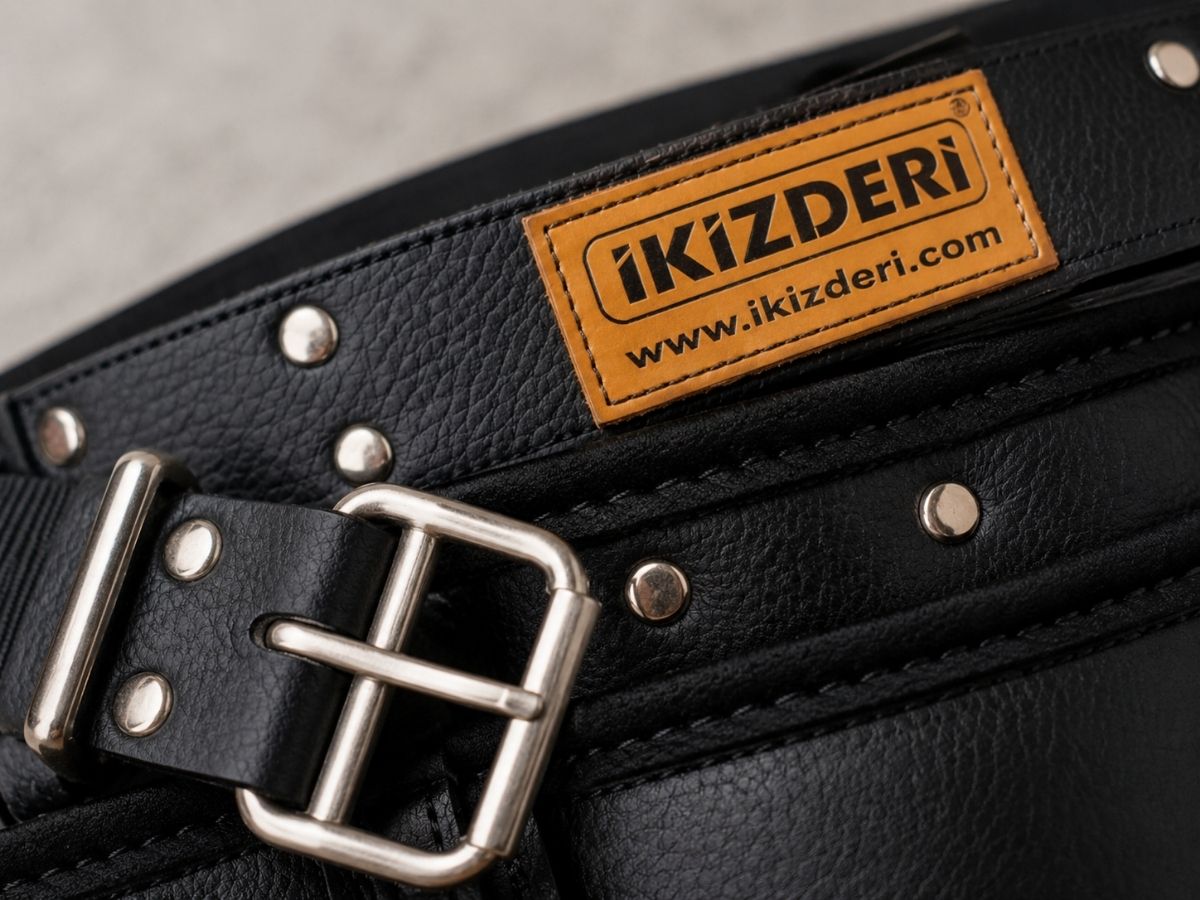
 İkizderi
 Rivets and hand stitching on a leather apron are the two silent heroes that decide how many years the product will last. No matter how good the leather is, if the stitching that holds the pieces together is loose, or if the load-bearing corners have no rivets, that apron will fall apart quickly. In this guide we explain what rivets and hand stitching actually do, which types exist, how to inspect them before buying, and how to care for them over time.
The Short Answer: Why Do Rivets and Hand Stitching Matter?
Rivets and hand stitching matter because every point on a leather apron that risks tearing is held by these two connections. Stitching joins the pieces along the whole seam; rivets take on the concentrated pressure that stitching alone cannot carry.
These two are not alternatives but complements. On a good apron, stitching and rivets work together: the stitching spreads the load, and the rivets lock the corners where the load collects. Below we open up both of them technically.
When buying an apron, most people look first at the leather and then at the number of pockets. Yet what really determines where the product will give up over the years is these two connections. Even if the leather on a cheap product looks good, loose machine stitching and alloy rivets will make it unusable in a short time.
What Is a Rivet and What Does It Do?
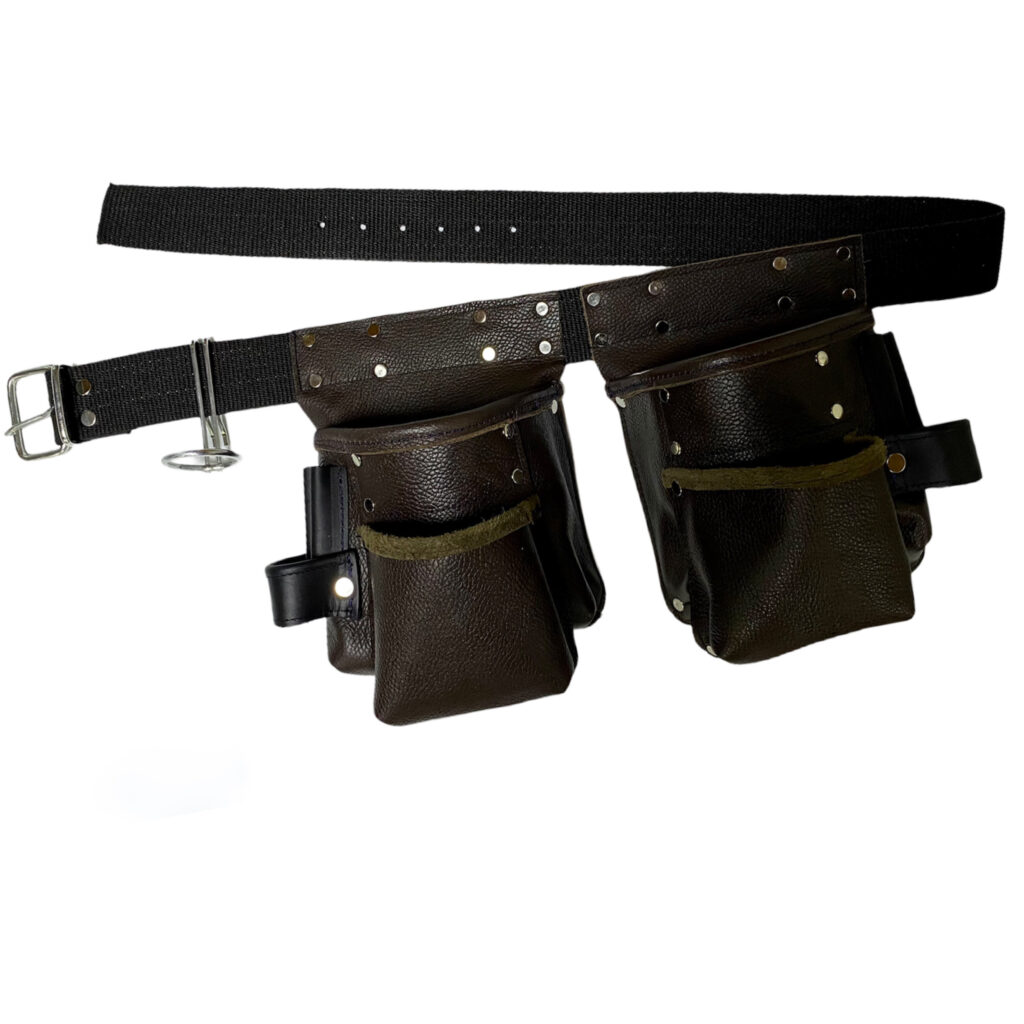
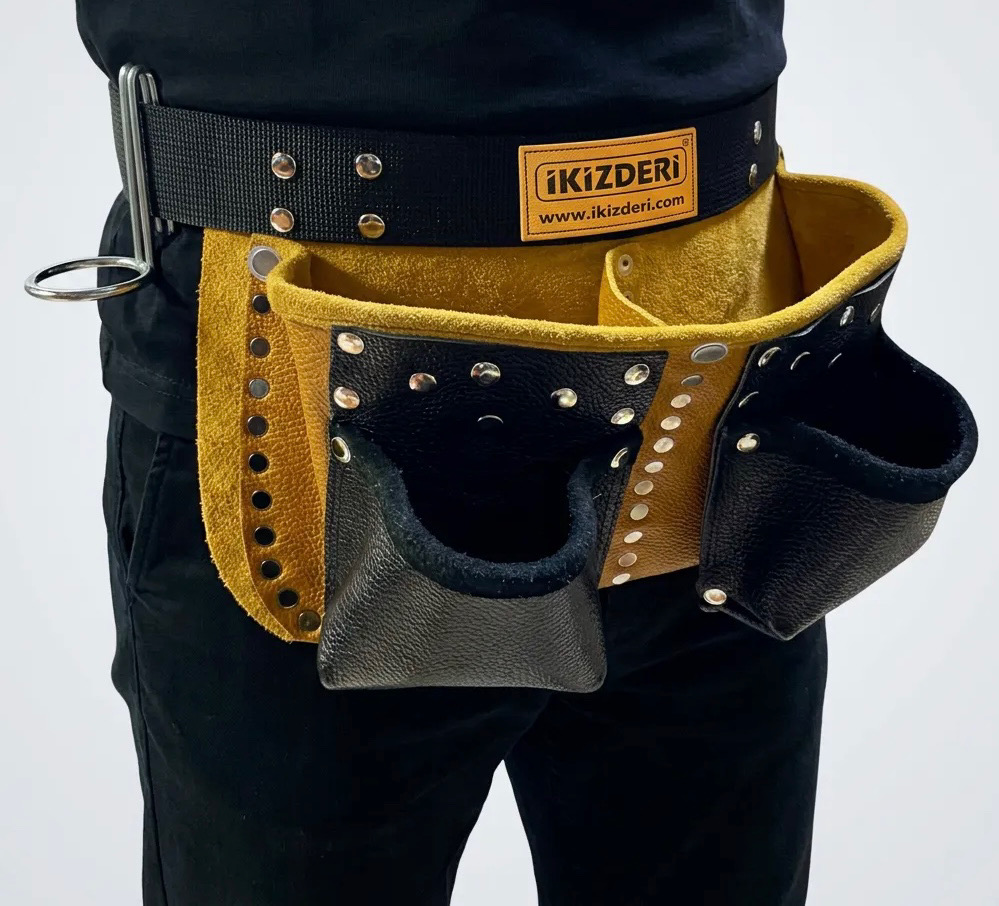
A rivet is a metal fastener that fixes two pieces of leather together by being closed and compressed from both ends. On leather aprons it is used at the most strained points, such as pocket corners and the belt attachment; it prevents the stitching from tearing by transferring the load onto metal.
A nail apron’s pockets fill with heavy tools and nails. That weight collects at a single point on the pocket’s opening corners and constantly pulls the leather downward. A corner held only by stitching opens up under this pressure over time. A rivet, however, grips the leather from both sides with a metal head and makes tearing at that point practically impossible.
What Is Hand Stitching?
Hand stitching is joining leather pieces with the craftsman’s hand rather than a machine, making every loop separately. Because the loops are independent of each other, when one stitch breaks the whole seam does not unravel; only that point opens.
This independence is hand stitching’s most critical property. On an apron carrying heavy tools, a single broken thread must not mean the product becomes completely unusable. Hand stitching gives exactly this guarantee. You can find every stage of handmade production in our how a handmade leather apron is made guide.
What Is the Difference Between Rivets and Stitching?
A rivet is a point connection made of metal; stitching is a flexible connection that continues along a line. They take on different jobs and give the strongest result when used together.
| Criterion | Rivet | Hand Stitching |
|---|---|---|
| Connection type | Point-based, metal | Along a line, flexible |
| Function | Locks concentrated pressure at one point | Spreads the load along the seam |
| Where it is used | Pocket corners, belt attachment | All joining lines |
| Weakness | Strains the leather if wrongly placed | Cannot carry corner pressure alone |
| Repair | Can be removed and replaced | A broken loop can be re-stitched |
As the table shows, each covers the other’s shortcoming. Stitching without rivets tears at the corner; a rivet without stitching cannot hold the pieces together along the seam.
Where Are Rivets Placed on a Leather Apron?
Rivets are placed at the points where load collects and pressure is most concentrated. These points are almost the same on every model.
- Both corners of the pocket opening: The most strained place as tools go in and out.
- Pocket base joint: Carries the full weight of heavy tools.
- Belt attachment point: The entire weight of the apron is transferred here.
- Strap and buckle connections: Exposed to constant pulling force.
- Tool loop and hammer holder: Absorbs sudden impact and shaking.
If you do not see rivets at these points, those are most likely the first places the apron will tear. What matters is not the number of rivets but whether they are in the right place.
Why Are Stainless-Steel Rivets Preferred?
Stainless-steel rivets are preferred because they do not rust in damp environments, do not break under impact, and keep their shape for years. Cheap alloy rivets rust and crack in a short time.
A work apron is in constant contact with sweat, rain, moisture, and dust. A rusting rivet first weakens as metal, then stains the leather around it and starts to rot it. So a rusty rivet ruins not only itself but the leather it holds.
Another advantage of stainless steel is its hardness. A rivet exposed to the blow of a hammer or heavy metal tools gets crushed and loses its grip if it is made of soft alloy. Stainless steel absorbs that impact for years without a problem.
What Types of Rivets Are There?
The most common rivet types in leather goods are double-cap rivets, single-cap rivets, and decorative rivets. The one that should be used on work aprons is the double-cap rivet, closed from both sides.
- Double-cap rivet: Grips the leather from both sides; the strongest type and the standard on work aprons.
- Single-cap rivet: Visible from one face only; used mostly on light products and for decoration.
- Decorative rivet: Appearance comes before function; not sufficient on its own at load-bearing points.
When inspecting an apron, look at the back of the rivet too. If it is properly closed from behind, the connection is sound; if the back is hollow or irregular, that rivet can pull through under load.
What Is the Saddle Stitch and Why Is It So Strong?
The saddle stitch is a hand-stitching technique in which two separate needles pass through the same hole from opposite sides. Because the thread locks twice in every hole, a broken loop does not affect the rest of the seam.
In machine stitching a single thread loops around itself as top and bottom; a break at one point can open a long section of the seam from end to end. In the saddle stitch, two separate threads lock into each other. Even if one thread breaks, the other keeps holding the pieces together.
Another advantage of the saddle stitch is that the thread is locked from two directions inside the leather. Thanks to this locking, the stitching does not slip when the product bends or stretches; the loops stay in place. In machine stitching, thread tension depends on a single mechanism, and when that tension is lost, loosening begins along the whole seam.
This is why the saddle stitch is still regarded as the most reliable method on leather goods that carry heavy loads. It is slow, entirely handwork, and therefore costly; but in terms of durability there is no substitute.
Why Are Stitch Holes Opened with an Awl?
In hand stitching the holes are opened with a sharp tool called an awl, which pushes the leather fibers aside instead of cutting them. Uncut fibers greatly slow down how fast the hole widens over time.
A machine needle, by contrast, cuts the fibers as it advances. Every cut fiber takes a little away from the leather’s carrying strength at that point. Over the years and under load, these holes widen, the stitching loosens, and the seam starts to open. Where holes are made with an awl, the fibers stay in place and the leather grips the thread tightly for far longer.
How Is the Stitching Thread Chosen?
Leather goods use waxed, thick, break-resistant thread. The better the thread quality, the longer the stitching lasts.
Waxed thread gives two advantages: the wax reduces the thread’s abrasion from friction inside the leather, and it stops the thread slipping inside the seam so the knot stays tight. The waxed surface also repels water to a degree, which matters for craftsmen working in damp environments.
Thickness is not a matter of taste either. Using thin thread on an apron that carries heavy tools makes the stitching weak from the start. Thick thread carries more load with fewer loops and means fewer holes are punched into the leather.
How Dense Should the Stitching Be?
On leather work aprons the stitching must be dense and regular; as the distance between loops grows, the seam’s carrying strength falls. Dense stitching spreads the load across more points.
With sparse stitching, the piece of leather between two loops has to take all the tension by itself, and over time the seam starts opening from that gap. With dense stitching the load is shared among many loops. That said, excessively dense stitching can also weaken the leather by perforating it; the right density is set by the craftsman’s experience.
When you hold an apron, look closely at the stitching: the loops should be regular, taut, and close together. Stitching that looks loose, sags, or is spaced irregularly is the clearest sign of careless workmanship.
Is It Better to Have More Rivets?
No. What matters is not the number of rivets but whether they are in the right place. More rivets than necessary perforate and weaken the leather and spoil the product’s flexibility.
Every rivet means a hole punched in the leather. A rivet placed where no load falls serves no purpose; it only weakens the leather at that point. On some cheap models rivets are used in large numbers not for strength but to “look strong”. That is a sign of missing workmanship, not of quality.
On a good apron the rivets are few but exactly where they need to be: pocket corners, pocket base, and belt attachment. The rest is the stitching’s job.
What Do Double-Layer Leather and Reinforcement Do?
Double-layer leather is reinforcement made by adding a second piece of leather at load-bearing points. Because the rivet and the stitching grip this thickened area, the connection becomes far stronger.
A rivet set into a single layer of leather can gradually tear through it under the pressure of heavy tools. Two layers spread the rivet’s pressure over a wider area and stop that progression. In the same way, stitching finds far more surface to grip on double-layer leather.
Using reinforcement at critical points such as the belt attachment and pocket base is one of the details that shows a craftsman’s experience. It goes unnoticed from the outside but directly extends the apron’s life.
How Can You Spot Weak Rivets and Stitching?
A weak rivet moves when you push it with your finger; weak stitching is loose, sparse, and irregular. Both checks can be done before you buy.
- Push the rivet with your finger: If it turns or has play, it was not set correctly.
- Look at the back of the rivet: A rivet not properly closed will pull through under load.
- Pull the stitching gently: If the loops separate without tension, the stitching is loose.
- Check the loop spacing: Irregular gaps mean the stitching was done carelessly.
- Inspect the pocket opening: If there are no rivets at the corners, that is where it will tear first.
Running these checks is the most practical way to tell a quality product from a cheap imitation. If you cannot hold the product, do not hesitate to ask the seller for close-up photos of the pocket corner and the belt attachment; a good maker is happy to show these details. To be sure the leather is genuine, also take a look at our how to tell if leather is real guide.
What Happens If a Rivet Rusts?
A rusting rivet first weakens as metal, then leaves rust stains on the leather around it and starts to rot it. This is why the rivet material directly affects the product’s life.
Rust works its way between the leather fibers and makes that area brittle. Over time the rivet hole widens, the rivet develops play, and eventually it pulls out of the leather. A stainless-steel rivet prevents this chain from the start. For plumbers and construction workers who work in damp environments, this detail is especially critical.
Can a Broken Stitch or Loose Rivet Be Repaired?
Yes. An area where hand stitching has broken can be re-stitched, and a loosened rivet can be removed and replaced. This repairability is one of the greatest advantages of handmade products.
Because the loops in hand stitching are independent, only the damaged section is redone; there is no need to unpick the whole seam. A rivet is removed with a special tool and a new one is set into the same hole. These operations can carry a product’s life well beyond decades.
On mass-produced aprons, by contrast, broken machine stitching often cannot be repaired, because re-stitching a seam that has opened along its length costs almost as much as the product itself. We compare all the differences between handmade and mass production in our why choose a handmade leather apron guide.
How Do Rivets and Stitching Affect the Price?
Hand stitching and stainless-steel rivets directly raise an apron’s cost, because both require time and skilled labor. These two details are the biggest reason for the price difference between two aprons made from the same leather.
Machine stitching takes minutes; hand stitching takes hours. A cheap alloy rivet costs pennies, while a stainless-steel rivet costs far more. And hand stitching and riveting are operations the craftsman must carry out one by one; they cannot be automated.
So judging an apron’s price by looking only at its leather is misleading. If one of two products using the same leather is machine-stitched with alloy rivets, it will have a far shorter life than the other.
How Do You Care for Rivets and Stitching?
Rivets should be kept dry, and the leather around the stitching should be nourished regularly. Leather that dries out and hardens starts to crack from the stitch holes.
When applying leather cream, do not neglect the seam lines; the leather there is the most stretched and the fastest to dry out. Dry a wet apron at room temperature, away from any heat source. Wiping the moisture that collects around metal rivets with a dry cloth reduces the risk of both rust and staining. We explain every care step in our how to care for a leather nail apron guide.
Conclusion: The Two Invisible Details Behind Durability
What determines a leather apron’s life is usually two details you do not see: stainless-steel rivets set at the right points, and dense, taut, hand-made stitching. However good the leather is, if these two connections are weak the product cannot last. An apron’s real quality is hidden in the corners where it is strained the most.
The good news is that you can check both before you buy. Spending a few seconds on the stitching and the rivets is the most valuable inspection you can make on a product you will use for years.
Hand stitching and stainless-steel rivets are standard on every model we make in our workshop in Gerede, Bolu. To see this workmanship up close, you can review our leather nail apron models and all İkizderi leather work equipment.