
 İkizderi
 How to tell if leather is real is the first question most craftsmen ask when buying a work apron, nail apron, or tool belt. Many products look like leather but are actually synthetic; they crack and peel within months, and your money is wasted. In this guide, we explain seven reliable ways to separate genuine leather from fake. Every method is simple, needs no tools, and takes just a few seconds at home. By the end, you will be able to judge the quality of a leather product the moment you hold it, and choose one that lasts for years and truly earns its price.
What Is Genuine Leather?
Genuine leather is real leather made by tanning an animal hide (usually calf, goat, or sheep) while preserving its natural fiber structure. Its main difference from synthetic leather is that its surface carries irregular pores and natural grain marks. With proper care it lasts more than ten years and develops a beautiful aging called patina.
Synthetic leather (PU leather, vegan leather, bonded leather) is made by coating a fabric base with plastic. It may resemble the real thing from a distance, but the difference appears up close. This is exactly why knowing how to identify leather directly affects your buying decision.
What Are the Types of Genuine Leather?
Not every genuine leather is the same quality. The three types you will meet most often are:
- Full-grain leather: The top, strongest layer of the hide. It is never sanded and keeps its natural texture. It is the most durable and longest-lasting type.
- Top-grain leather: Slightly corrected on the surface and a bit thinner. It is durable, but not as strong as full-grain.
- Synthetic / faux leather: Not leather at all. It is a plastic-based imitation with a short life.
Why Does Leather Quality Matter, Especially in a Work Apron?
In a work apron, leather quality directly determines the product’s lifespan. A weak material tears quickly in a product that carries heavy, sharp tools like nails, chisels, pliers, and tape measures all day. Genuine leather, on the other hand, resists impact, friction, and moisture for years.
Think of a concrete example: a synthetic apron looks fine in the first months, but under the constant pressure of nails and chisels it cracks at the corners, the pockets sag, and it often becomes unusable before a single season ends. A genuine leather apron holds its form for years under the same conditions. The difference shows up over time, not on day one, which is why choosing the right material from the start matters.
Three things make a master-crafted leather apron high quality: the type of leather, the strength of the stitching, and the durability of the rivets. At İkizderi, we produce our products in our workshop in Gerede, Bolu, with more than ten years of experience, from full-grain genuine leather, with stainless-steel rivets and master hand-stitching. When these three come together, the result is a lifetime product. You can review our different leather nail apron models and see that they all share one thing: genuine leather.
How to Tell if Leather Is Real: 7 Reliable Methods
Genuine leather is recognized by its distinctive smell, irregular pores, its ability to absorb water, the warmth it gives to the hand, and the way it chars rather than melts in a flame. The following seven tests need no tools and give results in seconds. Apply these steps in order before buying any product.
1. The Smell Test
Genuine leather has a natural, faintly earthy smell; synthetic leather smells of plastic or chemicals. This is the fastest way to identify real leather. Bring the product close to your nose: if you get a natural animal-hide scent, it is likely genuine. A sharp nylon smell means you are dealing with synthetic leather. A quick tip: in the shop, warm the product in your palm for a few seconds and smell it again; heat makes real leather’s natural scent stronger, while it makes synthetic leather’s plastic smell even worse.
2. Pore & Texture Check
Real leather has irregular pores and grain marks that differ in every area; synthetic leather has a repeating, flawless pattern. Look closely at the surface. Natural leather’s texture is never perfect, because it is natural. If the surface carries the same machine-printed, repeating pattern from edge to edge, that is the clearest sign of synthetic leather.
3. The Water (Absorption) Test
Genuine leather slowly absorbs a drop of water placed on its surface; synthetic leather holds the water on top as a bead. Put a drop of water on a hidden corner. If the water is drawn into the leather within a few seconds, it is genuine. If the drop stays on the surface like a ball, there is a plastic coating.
4. Touch & Warmth Test
Genuine leather absorbs the warmth of your palm and quickly feels warm and soft; synthetic leather stays cold and lifeless. Hold the product in your palm for a few seconds. Natural leather adapts to body temperature and gives a living feel. Synthetic leather usually leaves a cool, slippery, artificial touch.
5. Flex & Wrinkle Test
When you gently bend genuine leather, fine natural wrinkles form on the surface and the color lightens slightly; synthetic leather either does not wrinkle at all or folds like plastic. Bend the leather gently. Real leather wrinkles naturally, just like a hand, and returns to its old shape when you release it. This flexibility is proof of a living fiber structure.
6. Cross-Section & Edge Inspection
The cut edge of genuine leather is fibrous, matte, and full; the edge of synthetic leather shows a fabric base or a smooth plastic layer. Look at the edges, seams, and cut points of the product. In real leather the edge is one piece and natural. In synthetic leather you often notice the fabric weave underneath or a sharp plastic line.
7. The Flame Test (Use Caution)
When held to a flame, genuine leather does not catch fire easily, chars slightly, and gives a burnt-hair smell; synthetic leather melts quickly, shrinks, and gives off a sharp plastic odor. Because this test can leave a permanent mark, apply it only on a small, hidden corner and with great care. If you are unsure, the first six methods already give enough of a result.
Which of These Tests Is Most Reliable?
The most reliable approach is to use the smell, pore, and water tests together rather than trusting a single one. If all three give the same result, the margin of error is nearly zero. It is impossible to hide the plastic smell, the repeating surface pattern, and the water-repelling coating in one product at the same time.
The flame test gives a definite result, but it is the last resort because it can permanently damage the product. If you need to decide quickly in a shop, the smell and pore check alone are usually enough. These two tests expose synthetic leather within seconds.
Genuine Leather vs. Faux Leather: What Is the Difference?
Genuine leather is a natural, breathable material that lasts more than ten years; faux leather is a plastic-based, short-lived imitation. The table below lets you compare the two materials at a glance.
| Feature | Genuine Leather | Faux Leather (PU) |
|---|---|---|
| Smell | Natural leather scent | Plastic / chemical smell |
| Surface / pores | Irregular, natural pattern | Flawless, repeating pattern |
| Contact with water | Absorbs water | Holds water on the surface |
| Touch | Warm, alive | Cold, slippery |
| Durability | 10 years and more | Usually 2-3 years |
| Over time | Gains patina, improves | Cracks, peels |
| Price | Higher, economical long-term | Cheap, replaced often |
In short, faux leather looks cheap at first purchase but costs more in the long run because it must be replaced often. Genuine leather is bought once and used for years.
Which Leather Should a Work Apron Use?
The leather to choose for a work apron is full-grain genuine leather, because only this type provides the highest durability in a product that carries heavy tools. Thin or synthetic leathers cannot withstand the long-term pressure of hard tools like nails and chisels.
In a quality leather apron, workmanship matters as much as the leather. The stainless-steel rivets at the pocket corners keep the pocket’s shape under heavy load. Master hand-stitching prevents the seams from coming apart. These two details are standard in İkizderi products; every item is made from genuine leather, by hand, one by one.
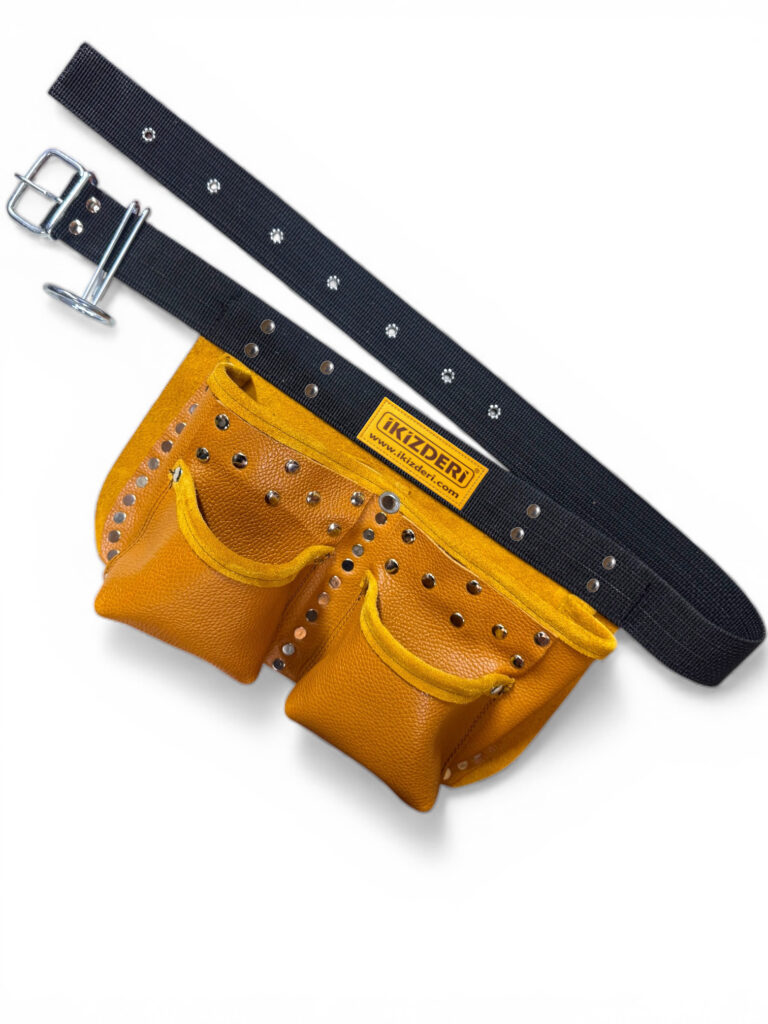
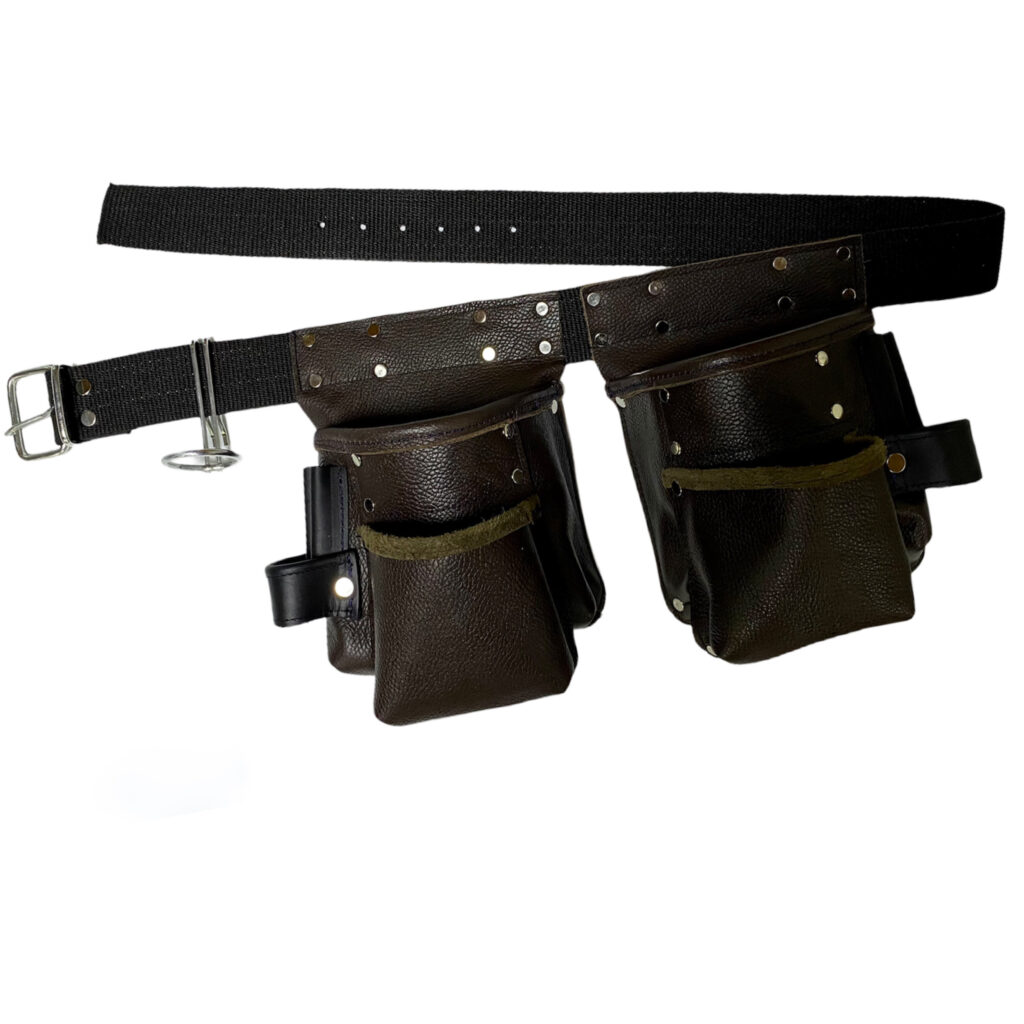
Different options exist for your needs. If you mostly carry nails and small parts, multi-pocket models; for general workshop work, our leather master apron range; and if you want a practical waist solution, our leather tool belt options will serve you. They all share the same core: genuine leather and master craftsmanship.
How Do You Care for a Genuine Leather Apron?
A genuine leather apron lasts far longer if it is wiped clean with a damp cloth and nourished every few months with a colorless leather conditioner. Leather is a living material; with the right care it stays like new for years.
For basic care, follow these steps:
- Wipe off dust and dirt with a dry or lightly damp cloth.
- If it gets wet, let it dry on its own, away from direct sun or heat sources.
- Every few months, apply a colorless leather conditioner to moisturize the leather.
- When not in use, store it in a cool, dry place away from sunlight.
Never machine-wash the leather or dry it on a heater or with a hairdryer; these permanently crack the leather.
What Do the Terms on a Leather Label Mean?
The wording on the label often reveals directly whether a product is real or synthetic leather. “Genuine leather” indicates real leather; “PU,” “vegan,” or “bonded” points to synthetic or reconstituted leather. So checking the label before testing saves time.
- Full-grain leather: The highest quality, most durable type. The natural surface is preserved without sanding.
- Genuine leather: Indicates real leather. Quality varies by type, but the material is real.
- Top-grain leather: Real leather with a lightly corrected surface. Durable.
- Bonded leather: Made by gluing leather scraps together. Low quality, wears out quickly.
- PU, PVC, vegan, faux leather: Not leather. Plastic-based synthetic material.
In short, if you see PU, PVC, vegan, or faux on the label, the product is synthetic leather no matter how much it looks like the real thing. When in doubt, confirm the label with the seven tests above.
Which Animal’s Leather Is Strongest?
For heavy-use products like work aprons, nail aprons, and tool belts, the strongest option is cowhide (calf) leather. Thanks to its thick, tight fiber structure, cowhide is the leather that best resists impact, pulling, and friction.
- Cowhide (calf) leather: Thick, sturdy, and durable. Ideal for work equipment.
- Goat leather: Light and flexible, resistant to abrasion. Often used in fine-craft products.
- Sheep leather: Very soft but thinner. Preferred in clothing and accessories, not suited to heavy work.
So when buying a tool bag or apron, it is worth asking whether the material is cowhide. This is why İkizderi products mainly use thick, durable genuine leather; the goal is for a product to last not years but decades.
5 Things to Check When Buying Genuine Leather
When buying a genuine leather product, check the type of material, the stitching, the rivets, the smell, and the maker’s transparency. These five points are enough to separate a quality product from an imitation.
- Ask about the leather type. Is it full-grain or top-grain? For heavy use, full-grain leather provides the longest life.
- Inspect the stitching. The stitching should be tight, straight, and even. Sparse or crooked stitching comes apart quickly.
- Check the rivets. Load-bearing pocket corners should have stainless-steel rivets. Rivets keep the pocket’s shape and prevent tearing.
- Apply the smell and pore tests. The tests at the start of this guide give results in seconds.
- Trust transparency. Prefer brands that clearly state where and how the product is made. İkizderi makes its products by hand in its workshop in Gerede, Bolu, and states this openly.
You can apply the same five checks while reviewing our leather tool apron range made for different trades. When the right material and workmanship come together, the product serves for years without needing to be replaced.
Common Myths About Genuine Leather
The most common mistake with genuine leather is deciding based on price or appearance. The four myths below lead many people to mistake synthetic leather for real.
“Any expensive leather is genuine”
This is not true. A high price alone is not proof of real leather; some synthetic products are sold at high prices too. Price is only a clue, not definite proof. Always apply the smell, pore, and water tests before deciding.
“Genuine leather is waterproof”
The opposite. Genuine leather absorbs water, which is exactly why it needs regular care. A material that holds water on the surface like a bead is usually synthetic leather. This is why the water test is one of the most reliable ways to identify real leather.
“Odorless leather is fake”
Partly true. Some well-processed leathers smell only very faintly, and that is normal. But if you get a sharp plastic or chemical smell, it is definitely a sign of synthetic leather. Natural leather’s scent is not unpleasant; it is mild and earthy.
“Real leather never scratches”
Wrong. Genuine leather can scratch; however, a light surface scratch often disappears when rubbed with a finger or blends into the patina. This flexibility is actually a mark of quality. In synthetic leather the scratch is permanent and turns into peeling over time.
If you are also weighing canvas aprons against leather, take a look at our full leather vs canvas nail apron comparison.
If you also wonder how long a leather apron lasts, see our how long does a leather work apron last guide.
To compare synthetic and real leather in detail, see our faux leather vs genuine leather guide.
To soften stiffened leather, see our how to soften leather guide.
Summary: Recognizing Genuine Leather in 10 Seconds
The answer to how to tell if leather is real is actually simple: smell it, touch it, look at the pores, and drop a bit of water on it. Natural scent, irregular texture, water absorption, and warmth to the hand are the most reliable signs that a product is real leather. This quick, few-second check reveals the difference between a product that lasts for years and an imitation that wears out in months.
Remember: although genuine leather looks more expensive than synthetic at first purchase, it is far more economical in the long run because it lasts for decades. Instead of a cheap product replaced again and again, a real leather product you buy once and use for years is always the smarter investment. Especially in a work apron used every day, this difference shows in both your budget and your comfort.
If you want to be sure of the material, you can review the İkizderi leather work equipment, all made from genuine leather with master craftsmanship, and choose the model you are looking for with confidence.